
What Is Myofunctional Therapy — And Does My Child Need It?
By Dr. Kristen Sander, DDS, MS — practicing orthodontics since 2016 | Read Dr. Sander's full bio
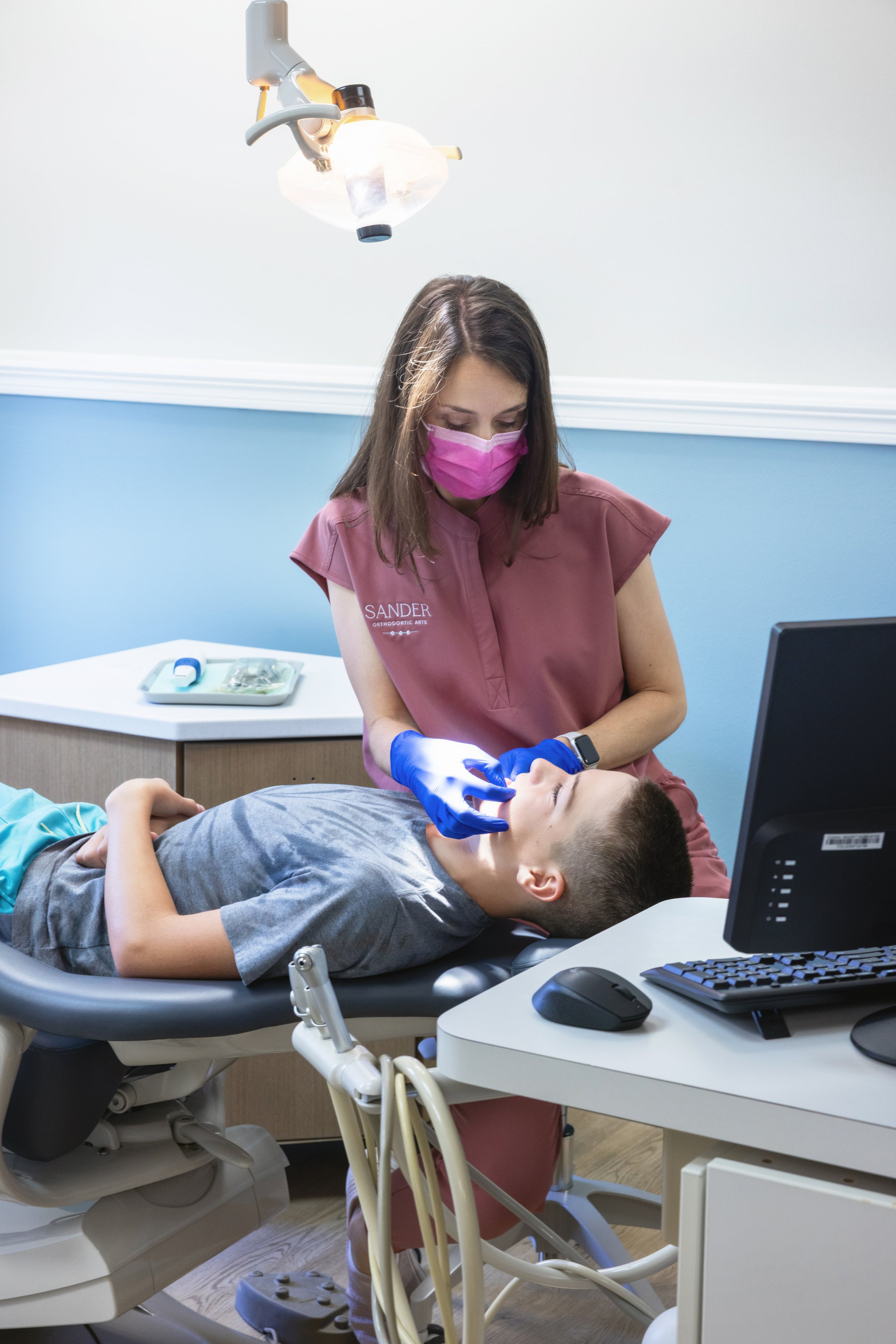
If you've come across the term "myofunctional therapy" while researching your Andover or Wichita child's bite, you're probably wondering whether it's something they need alongside, or instead of, orthodontic treatment. The short answer: orofacial myofunctional therapy (OMT) is a set of exercises and behavioral retraining focused on tongue posture, lip seal, breathing patterns, and swallowing, not orthodontic treatment, and not something every patient needs. As part of every orthodontic workup at my Andover practice, I evaluate whether a patient's tongue posture or swallowing pattern could work against our treatment goals. In select cases, I recommend an evaluation with a trained myofunctional therapist as an adjunct to what we're doing orthodontically. I don't provide myofunctional therapy in my office; when an evaluation seems worthwhile, I refer to an appropriately trained provider. Below is a closer look at what OMT actually is, how to know if it's worth a conversation, and where it fits alongside orthodontic care.
This post is general educational information and isn't a substitute for an individualized evaluation. If you have concerns about your child's bite, breathing, or oral habits, the best next step is an exam.
What Is Orofacial Myofunctional Therapy?
OMT involves exercises and behavioral retraining intended to improve resting tongue posture, lip posture and seal, nasal breathing patterns when appropriate, swallowing patterns, and coordination of the muscles of the mouth and face. It does not move teeth the way braces or clear aligners do, and it isn't a routine part of orthodontic treatment for every patient.
The American Association of Orthodontists (AAO) has historically taken a measured view of OMT, its early guidance questioned efficacy, and more recent AAO commentary is skeptical of related popular concepts while treating properly administered OMT as a reasonable adjunct in select cases.
What Is a Tongue Thrust, and Why Does It Matter?
"Tongue thrust" generally describes a swallowing pattern where the tongue moves forward or between the teeth rather than staying in a more typical position. But swallowing is only part of the picture, resting tongue posture matters just as much, since teeth are exposed to light forces from the tongue, lips, and cheeks for many hours each day.
A tongue-forward posture or atypical swallow can sometimes appear alongside:
An anterior open bite
Spacing or flaring of the front teeth
Difficulty keeping the lips comfortably together at rest
A mouth open resting posture
Certain speech patterns
It's important to note that association isn't the same as causation. A tongue posture or swallowing pattern can sometimes be an adaptation to a child's anatomy, airway, enlarged tonsils or adenoids, oral habits, or other factors. In many cases, we can't say definitively that the tongue "caused" the bite.
How Would I Know If My Child Needs This?
I wouldn't encourage parents to self diagnose tongue thrust based on a single observation. In my Andover practice, signs I look for that might warrant a conversation include:
The tongue visibly coming between the front teeth during swallowing or at rest
An open bite where the front teeth don't overlap
A persistent mouth open posture
Difficulty comfortably closing the lips at rest
A bite that seems resistant to correction or tends to reopen
Certain persistent speech concerns
A history of prolonged oral habits, such as finger or thumb sucking or extended pacifier use
Having one of these signs doesn't automatically mean a child needs Myofunctional therapy — it's a reason to bring it up, not a diagnosis on its own.

When I Might Recommend a Referral
I consider a referral case by case, not routinely, typically when I see a persistent tongue posture or swallowing pattern that could interfere with orthodontic correction or long term stability. An open bite is one situation where I pay particular attention to tongue posture and function. I may also consider a referral when a functional habit persists despite correction of the dental problem itself.
The goal isn't to add another item to every child's treatment list. It's to identify the smaller group of patients where addressing both structure and function is worth the added time and financial investment.
What About Airway Concerns?
If a child seems to have difficulty breathing comfortably through the nose, the first question shouldn't simply be how to train them to keep their mouth closed. Mouth breathing can have multiple causes, including nasal obstruction or enlarged tonsils and adenoids. Myofunctional therapy shouldn't substitute for appropriate medical evaluation when an airway concern is suspected, depending on the findings, I may recommend evaluation by a child's pediatrician, ENT, allergist, or another appropriate provider. Therapy aimed at establishing a nasal-breathing pattern only makes sense once a child can physically breathe adequately through the nose. It's also worth noting that myofunctional therapy does not skeletally expand the palate the way an orthodontic palate expander does.
Does Myofunctional Therapy Replace Braces or Invisalign?
No. OMT and orthodontic treatment address different things. Braces, aligners, and other orthodontic appliances are designed to move teeth and, in growing patients, may guide or support dental and facial growth. Myofunctional therapy focuses on muscle patterns and oral function. In a patient who needs both, the two can complement one another but OMT shouldn't be presented as a way to straighten teeth, expand jaws, or correct a significant bite issue on its own.
Who Actually Provides It?
Myofunctional therapy may be provided by professionals with additional training in orofacial myology, commonly speech language pathologists or dental hygienists, depending on their credentials and scope of practice. "Myofunctional therapist" can describe people from different professional backgrounds, so training matters. When I recommend it, I refer the patient rather than providing the therapy myself, and ideally the orthodontist and therapist stay in communication about what we're seeing and trying to accomplish.
Does Myofunctional Therapy Help With Speech Issues?
Myofunctional therapy isn't automatically the answer to a speech concern. Some tongue posture patterns coexist with speech articulation issues, and a speech language pathologist is the right professional to evaluate those. Some SLPs are trained in Myofunctional therapy and can serve a dual role, but not all are depending on the child, speech therapy, Myofunctional therapy, orthodontic treatment, or some combination may be the right path.
Frequently Asked Questions
Does Sander Orthodontic Arts provide myofunctional therapy in office? No. When an evaluation seems appropriate, Dr. Sander refers patients to a trained Myofunctional therapist rather than providing the therapy directly.
Is Myofunctional therapy a standard part of orthodontic treatment? No. It's considered case by case, typically when a persistent tongue posture or swallowing pattern appears likely to affect orthodontic correction or stability, not as a routine addition to every treatment plan.
Can Myofunctional therapy fix my child's bite on its own? No. It doesn't move teeth or skeletally expand the palate the way orthodontic treatment does. It addresses muscle function and can complement orthodontic treatment in select cases, but it isn't a substitute for it.
What should I do if I notice signs of tongue thrust in my child? Bring it up at your next orthodontic visit. Signs like an open bite, visible tongue placement during swallowing, or a persistent mouth open posture are worth a conversation, not a reason to self diagnose.